What is Cervical Cancer?
Cervical cancer (cervical carcinoma) is a malignant disease that develops in the lower part of the uterus – known as the cervix.
In most cases, the disease is caused by a persistent infection with certain high-risk types of the human papillomavirus (HPV). These viruses are primarily transmitted through sexual contact and are widespread worldwide.
How does Cervical Cancer develop?
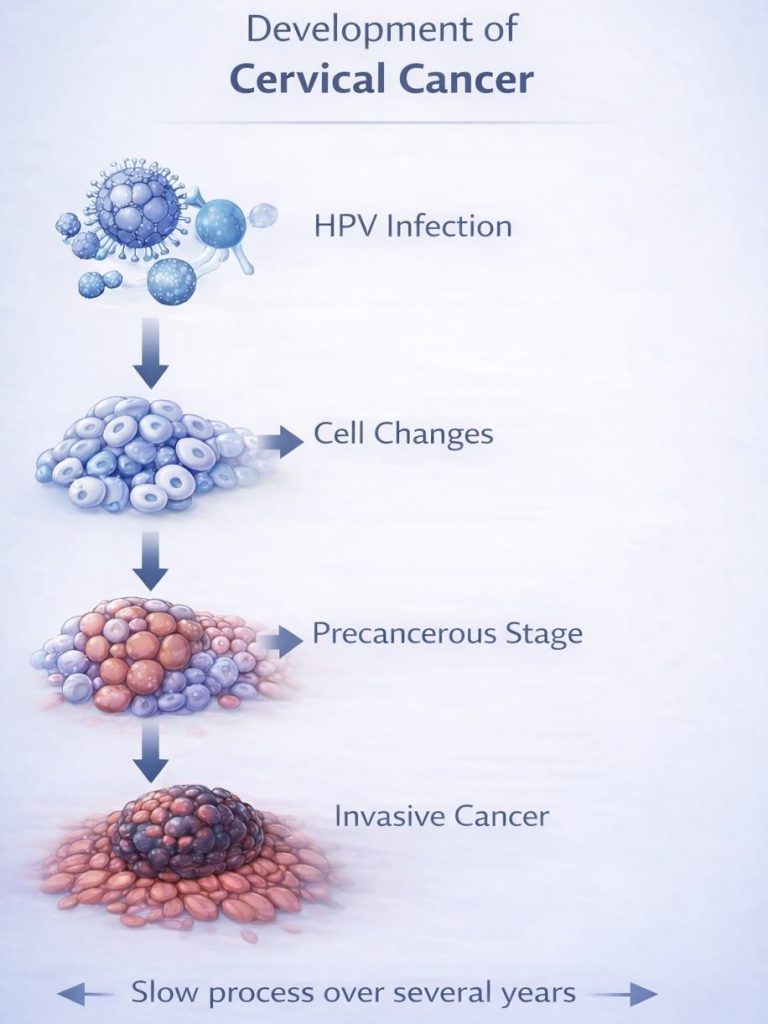
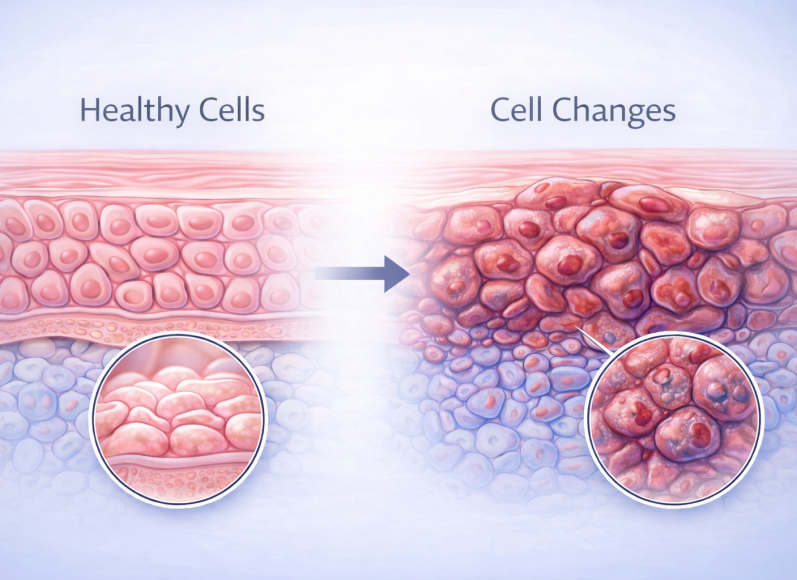
An HPV infection often resolves on its own. However, if the infection persists for several years, it can lead to cellular changes in the cervix.
This process develops gradually:
- Persistent high-risk HPV infection
- Development of cellular abnormalities (precancerous lesions)
- Progressive tissue changes
- Invasive cervical cancer
Several years – or even decades – may pass between the initial infection and the development of an invasive tumor.
It is precisely this long development period that provides a critical window of opportunity for prevention and early detection.
Why is the disease often detected too late?
A central challenge is that cervical cancer typically causes no symptoms in its early stages.
Affected women often feel healthy and do not notice any changes.
The first symptoms usually appear only once the disease has already progressed. These may include:
- Unusual bleeding (e.g., after sexual intercourse or between menstrual periods)
- Lower abdominal pain
- Pain during sexual intercourse
- Unusual vaginal discharge
- General weakness or unexplained weight loss
By this stage, the disease is often more advanced, which makes treatment more complex and challenging.
Why do women still die from Cervical Cancer?
Today, cervical cancer is preventable and treatable in many cases — provided it is detected early.
Nevertheless, hundreds of thousands of women worldwide die from this disease each year.
The main causes include:
- Lack of access to regular screening examinations
- High medical costs
- Insufficient infrastructure in rural or low-income regions
- Lack of awareness about risks and prevention options
When the disease is diagnosed at an advanced stage, the chances of successful treatment decrease significantly.
A Gradual but Preventable Process
Cervical cancer usually begins with microscopic cellular changes that remain unnoticed for a long time. Many years can pass between an HPV infection and the development of an invasive tumor.
It is precisely this long development phase that is critical:
As long as cellular changes are detected early, they can be medically monitored or treated.
The disease becomes particularly problematic when regular testing is not performed. Without proper diagnostics, a high-risk HPV infection often remains undetected — until structural tissue changes have already progressed.
The high global mortality rate is therefore less a medical issue than an issue of access.
Our Contribution
Our Contribution
As an international health initiative, Najla Care International Solutions is committed to breaking this cycle.
Through innovative and accessible HPV testing solutions such as CarciScan, we enable the early identification of high-risk infections — before cancer develops.
Our goal is to structurally anchor prevention and ensure that women worldwide have reliable access to modern diagnostic services.